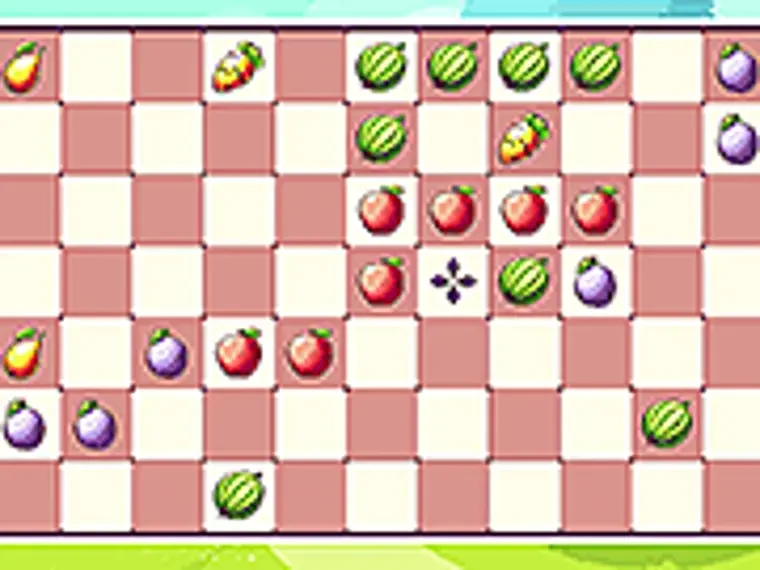
Read the spaces, not just the colours
The gaps are resources. A short route through empty cells can become unavailable after new pieces appear, so consider which corridor your planned line will need before spending a move on a nearby distraction.
Keep the target reachable. A nearly complete row is not helpful if its missing fruit sits behind blocked cells, which is why checking the route belongs in the same decision as choosing the destination.
Every non-match changes the board
Three new fruits arrive. The source describes this after a move that does not create a match, so a move that looks harmless can leave you with less working space than you expected.
Plan one move beyond the attractive one. Ask what the board would need next if your move fails to clear a line, rather than assuming that the empty spaces you can see will remain available indefinitely.
Prefer room over a decorative arrangement
A tidy board is not the goal. Keep options for horizontal and vertical lines, and resist filling a useful corridor merely to group colours together when those groups have no clear route to a match.
What to do with your hands
| Input / rule | What it does |
|---|---|
| Select a fruit | Choose the piece to move |
| Select an empty destination | Move if a clear path exists |
| Horizontal / vertical row of five | Make matching fruits disappear |
Three things to keep in mind.
Original MolaPiko diagrams explain decisions. They are not screenshots or a reproduction of the game screen.
When an attempt goes sideways.
Picking a destination without a route
Trace the empty-cell path before committing.
Ignoring the three new pieces
Leave spare cells after moves that do not match.
Counting a diagonal as a line
Build horizontal or vertical rows as described by the source.
The reason. And the catch.
Our quietest-looking thinking choice, with a catch. The board rewards patient planning, but spare space disappears quickly when moves fail to make lines, so the relaxed appearance should not be mistaken for a puzzle without consequences.
- +
- Simple rules produce meaningful movement and space decisions.
- −
- Blocked paths and new pieces can punish casual rearranging.
Choose it for
Players who like thinking about the next board position.
Try another if
Anyone wanting a fruit-slicing reaction game.
Before you open the game.
Is this a match-three game?+
The target is five. You move fruit into horizontal or vertical lines through available paths, rather than swapping adjacent pieces to make a three-item match as you would in many other fruit puzzles.
Why did the fruit refuse to move?+
Check the path first. A destination can be empty while the route to it is blocked, so look for connected free cells between the selected fruit and the square you wanted to use.
When do new fruits appear?+
After a move without a match. The source specifies three new pieces, making spare space a practical part of your plan rather than an empty area that you can assume will stay open.
Where these notes come from
We separate published facts from suggested tactics. Device and control notes come from the linked edition; our opening sequence, mistake checks and conclusion are editorial reasoning, not a claim of a complete personal playtest.
Y8 — Fruit Lines